
Hi, I'm Tirth Gada.

I'm a third-year electrical engineering student at VJTI Mumbai with a minor in robotics. I've been working in robot learning for over a year, and what interests me is deploying policies on real hardware to find out which ones hold up, what they lack, and what makes them generalise.

I've chased that through sim-to-real RL for manipulation, tactile sensors I built for visuotactile imitation learning, and Open Duck Mini, an open-source bipedal platform running RL policies onboard.

I'm currently working on democratising the entire robot learning stack to develop robot foundation models.

Tirth Gada standing in front of two Franka arms in the lab

One continuous thread: train it, deploy it, see what breaks.

01

I started with what felt like the toughest challenge out there: sim2real.

Taking RL policies trained entirely in simulation and deploying them on real hardware. Building on Stone Tao's work, I deployed sim2real cube picking with PPO on the SO-100 arm, then tested FPO and FPO++ against it on the same task.
PPO in simulation — the SO-100 learning PickCube in ManiSkill.
Same policy, real arm — zero-shot cube picking.
FPO++ in ManiSkill — flow policy optimisation on the same task.
02

Then locomotion, so sim2real covered both ends.

I built Open Duck Mini, an open-source bipedal platform, and ran RL walking policies onboard. Manipulation and locomotion, both trained in sim and both walking out into the real world. A humanoid is manifesting soon.

The build — assembling Open Duck Mini.
Sim2real walking — RL policy running on the duck.
03

Then I wanted to push the limits of extracting value from robot data.

I tried out vision-only ACT, and worked on visuotactile policy learning using FlexiTac, piezoresistive tactile sensors. I also deployed a B-spline diffusion policy on the YAM arms using data collected with our VR teleop kit.

Vision-only ACT — behaviour cloning from RGB alone.
Visuotactile ACT deployed — with our FlexiTac tactile sensor on the gripper.
Tactile heatmap — live readout from the sensor.
B-spline diffusion policy rollouts — trained on VR teleop data.
The VR teleop stack — episode 29 of bimanual towel folding: the operator (me lol), plus the top, left-wrist and right-wrist cameras the policy sees. Dataset on Hugging Face: bimanual-fold-pink-towel-vr.
04

Now: hill-climbing foundation models with our own stack.

VR teleoperation on bimanual YAM arms for human-in-the-loop corrections, and fine-tuning VLAs on what comes back. The question is still the same one I started with: what holds up on real hardware, and what makes it generalise.

Bimanual cloth folding on the YAM arms — autonomous rollout.

A robotics club, and a lab that threw me in the deep end.

SRA, VJTI's robotics club, with my friends.

We taught Wall-E, a line-following and self-balancing robot, and MARIO, a ROS 2-based manipulator, to 200+ first-years, trying to light the same spark that was lit in me when I sat in those workshops in my own first year.

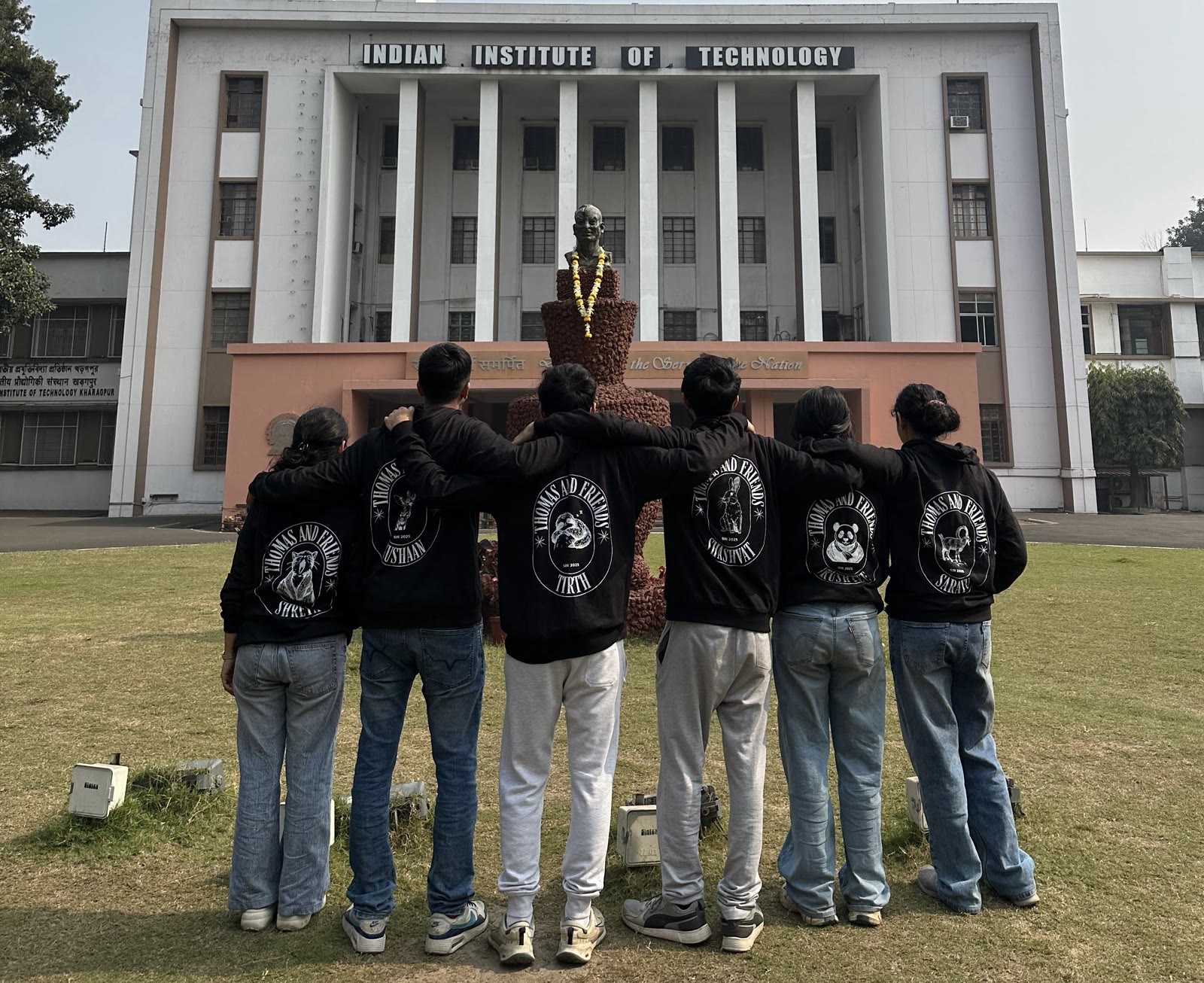
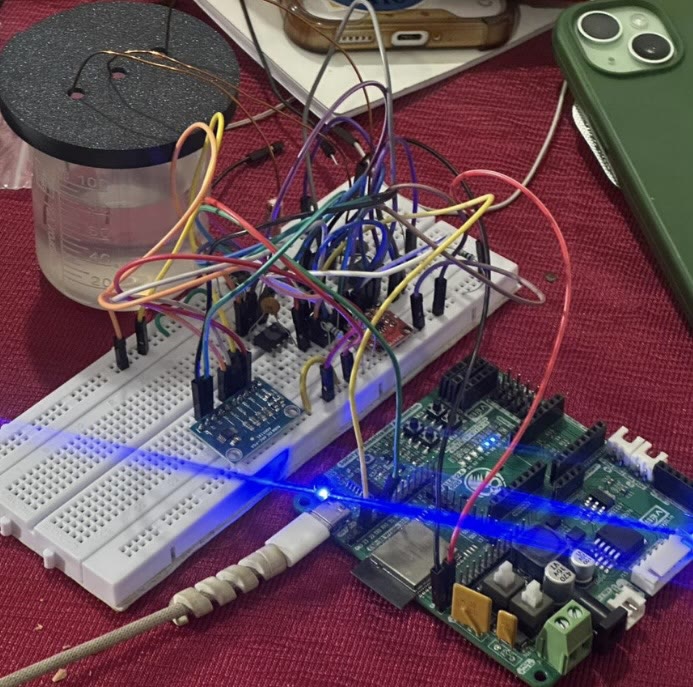
We also reached the finals of SIH 2025, India's largest hackathon, where we tried to find the best possible way to test gold purity without invasive methods.

Wall-E — self-balancing.
MARIO — ROS 2 motor sweep at the workshop.
SIH 2025 finalist team at IIT Kharagpur
SIH 2025 finals — the team at IIT Kharagpur.
Breadboard prototype for non-invasive gold purity testing
Gold purity testing — the non-invasive prototype.

HiRO Lab, IISc: hammered into research I had no prior knowledge of.

Learning from a single generated video demo, for which I had to optimise object and hand tracking. And pretraining multi-embodiment grasping agents like Kinematics Flow and GeoMatch.

Object tracking — M3T on a handheld object.
Hand tracking — mesh render overlay.
Hand tracking — flow overlay.
Kinematics Flow on DexEE — 86.1% grasp success rate.